
Critical Contraints: When Leadership Itself Is the Obstacle
Why your organization lurches between bureaucratic rigidity and chaotic adaptiveness, and how to find productive balance.


[This post is helpful reading on its own, so feel free to read on, however it's intended for anyone who completed the Disruption-Fluency Self-Assessment. I encourage you to start there.]
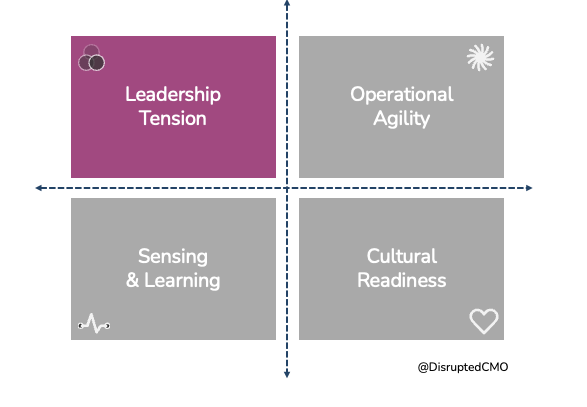
If your Disruption Fluency Self-Assessment identified Leadership Tension as your lowest-scoring dimension, you're facing a challenge that's simultaneously the most important and the most personal: the way leadership is practiced in your organization is preventing it from thriving through disruption.
Organizations weak in Leadership Tension management exhibit characteristic patterns: either bureaucratic rigidity that stifles innovation, or chaotic adaptiveness that prevents scale. Leaders consistently apply the wrong approach to the situation at hand. The creative tension that should fuel innovation becomes destructive conflict.
This isn't just about what leaders do, it's about how leadership functions as a system. And as CMO, you're at the center of that system.
What Leadership Tension Actually Means
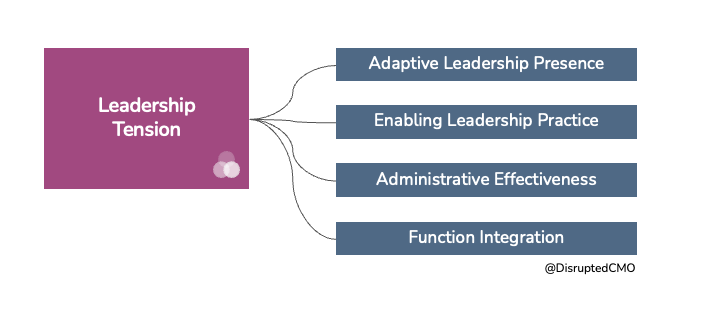
In the Disruption-Fluent Marketing framework, Leadership Tension is defined as "the degree to which marketing leaders effectively manage the polarities that define the dynamic interplay between the framework's leadership approaches." It draws from Complexity Leadership Theory, which identifies three "entangled" leadership functions:
Adaptive Leadership is the emergent, creative problem-solving that occurs when diverse stakeholders collaborate to address novel challenges. In marketing, this looks like cross-functional teams rapidly pivoting campaigns, marketers developing new approaches to emerging challenges, and innovation emerging from practitioners closest to the work. Adaptive leadership is emergent rather than mandated, thrives on productive tension, and requires psychological safety to flourish.
Administrative Leadership represents traditional management functions: planning, organizing, coordinating, and controlling. In marketing, this includes approval processes, budget planning, performance measurement, brand governance, and technology operations. Far from obsolete, thoughtful administrative leadership provides stability, enables scale, and creates the operational foundation adaptive work depends on.
Enabling Leadership is the critical bridge between adaptive and administrative functions. It creates "adaptive space" where innovation can flourish while managing the tension between bureaucratic needs and creative emergence. In marketing, this means securing resources for experiments, protecting team capacity for creative headspace, shielding emergent solutions from premature control, and translating adaptive innovations into scalable operations.
The Entanglement Challenge
The difficulty lies in "entanglement": these functions are deeply interconnected and in constant dynamic tension. This isn't a problem to solve, or a perfect balance to attain, but a polarity to manage.
Barry Johnson's work on Polarity Management distinguishes between problems (which have solutions) and polarities (which must be managed over time). The relationship between adaptive and administrative leadership is a classic polarity: both are necessary, neither is sufficient alone, and over-emphasizing either creates problems.
Too much administrative control stifles innovation, de-motivates team members, slows response to opportunities, creates compliance-oriented culture, and drives away adaptive talent.
Too much adaptive chaos prevents scale, consumes resources on non-strategic initiatives, fosters burnout from constant change, loses strategic coherence, and undermines stakeholder confidence.
The goal isn't to eliminate tension, it's to make productive use of it. As the framework articulates: "The goal isn't to eliminate the natural tension between stability and innovation. It's to make productive use of that tension to fuel creativity."
Why This Is Your Critical Constraint
Leadership Tension serves as "the connective tissue" integrating the other dimensions. Without effective management, Operational Agility lacks appropriate governance. Sensing & Learning insights don't translate. Cultural Readiness erodes as leaders consistently apply the wrong approach.
Research from the Center for Creative Leadership emphasizes that "polarities and paradoxes require leaders to tolerate the discomfort that goes along with the natural tension in the system." Leaders who can't tolerate this tension, who resolve it prematurely by over-emphasizing one pole, undermine organizational effectiveness.
Diagnosing Your Specific Pattern
Low Leadership Tension scores manifest in different patterns. Understanding yours shapes how you respond.
The Over-Administered Organization: Multiple approval levels for most decisions. Innovation only in sanctioned programs. Risk aversion preventing experimentation. "That's not how we do things here" as common response to new ideas. Administrative leadership has expanded to crowd out adaptive and enabling functions—often a response to past failures or transitions that prioritized control.
The Under-Administered Organization: Constant change without strategic coherence. Initiatives proliferating without governance. Burnout from perpetual pivoting. Good ideas that never scale. Adaptive leadership is valued but administrative and enabling functions are underdeveloped—common in fast-growth or innovation-proud organizations.
The Enabling Gap: Tensions between creative and operational teams. Innovations dying when they hit "the system." Pilot programs that never scale. Senior leaders exhausted from managing constant conflict. Both adaptive and administrative functions exist, but enabling leadership is underdeveloped. This is the most common pattern because enabling leadership is the least understood function.
Context-Blind Application: Same leadership approach regardless of situation. High-uncertainty work managed like routine operations. Routine operations disrupted by inappropriate adaptiveness. Leaders lack the diagnostic capability to determine which approach is appropriate.
The Path Forward: Building Leadership Tension Capability
Developing Adaptive Capacity
- Create space for emergence. Designate 10-20% of resources for experimental initiatives with different governance than routine operations. Protect this space from administrative interference.
- Recognize and nurture adaptive leadership when it emerges. Adaptive leadership often appears informally. Learn to recognize it and support it rather than suppressing it.
- Tolerate productive tension. Adaptive work involves disagreement, iteration, and uncertainty. Leaders who demand premature closure inhibit adaptive dynamics.
For more on creating environments where adaptive work can thrive, read Harness Productive Tension to Fuel Marketing Innovation.
Developing Administrative Excellence
- Apply Minimum Viable Bureaucracy. Create the smallest amount of administrative structure necessary to enable rather than constrain your team's ability to respond with agility. Not less administration, but right-sized administration.
- Match governance to risk. Develop tiered approaches where routine, low-risk work moves quickly while high-stakes decisions get appropriate scrutiny.
- Distinguish stable from dynamic work. Some work benefits from consistency and control. Ensure administrative excellence in these areas even as you build adaptiveness elsewhere.
Read more: Minimum Viable Bureaucracy: The Secret to an Agile Marketing Team.
Developing Enabling Capability
This is often the highest-leverage path to focus on because enabling leadership is often the most commonly underdeveloped.
- Train leaders as boundary spanners. Help senior leaders see their role as managing the interface between adaptive and administrative systems, not just overseeing one or the other.
- Develop tension management skills. Teach leaders to hold productive tension rather than resolving it prematurely. This includes comfort with ambiguity and the ability to reframe conflicts as both/and rather than either/or.
- Create translation mechanisms. How do adaptive innovations become scaled operations? Who owns this transition? Without explicit enabling mechanisms, innovations die at the boundary.
- Shield adaptive work appropriately. Enabling leaders protect emerging innovations from premature bureaucratic control while maintaining accountability.
Building Diagnostic Capability
- Develop shared language. When your leadership team can distinguish between adaptive, enabling, and administrative contexts, you make better collective decisions about approach.
- Create decision frameworks. What characteristics indicate a situation calls for adaptive vs. administrative approaches? Document and share these frameworks.
- Practice situational diagnosis. In leadership meetings, regularly ask: "What type of challenge is this? What leadership approach does it require?"
The CMO's Unique Role
As CMO, you occupy a particularly challenging position in the Leadership Tension landscape:
- You span boundaries by nature. Marketing inherently bridges creative and operational, strategic and tactical, brand and performance. Your role requires enabling leadership capacity to operating effectively and help lead your team across them all.
- You face multiple stakeholders with different expectations. The CFO may want administrative discipline. The CEO may want adaptive innovation. Your team may want creative freedom. You must navigate these tensions.
- You model what's possible. When you effectively manage leadership tensions, you demonstrate to the organization that it can be done.
Before trying to change others, examine your own tendencies: Do you default to administrative control when anxious? Do you undervalue operational discipline in favor of creative freedom? Are you effective at the enabling function? Your behavior sets the tone.
The Payoff
When Leadership Tension management improves, everything else in the Disruption-Fluent Marketing framework gains coherence. Operational Agility finds the appropriate level and depth of governance. Sensing & Learning connects insights and learnings to action in realtime. Cultural Readiness becomes the sustainable foundation it needs to be.
Most importantly, your organization develops capacity to thrive amid complexity, not by choosing between stability and innovation, but by managing the productive tension between them.
Next Steps
- Assess your personal tendencies. Which leadership function is your default? Which do you neglect?
- Diagnose your organization's pattern. Over-administered, under-administered, enabling gap, or context-blind?
- Build shared language with your leadership team. Create common vocabulary for discussing these dynamics.
- Identify one boundary to strengthen. Where is enabling leadership most needed? Focus development there.
To assess where your organization stands across all four dimensions of disruption fluency, explore the Disruption Fluency Audit.
In the meantime, please feel free to reach out to start a conversation!


