
Critical Constraints: Operational Agility, When Speed Matters
Why great marketing ideas keep dying in execution, and how to build an organization that can actually move.


[This post is helpful reading on its own, so feel free to read on, however it's intended for anyone who completed the Disruption-Fluency Self-Assessment. I encourage you to start there.]
If your Disruption Fluency Assessment identified Operational Agility as your lowest-scoring dimension, your organization faces a fundamental execution problem: you may know what needs to change, but you can't change fast enough to capitalize on it.
Organizations weak in Operational Agility exhibit a frustrating pattern: good ideas die in implementation. Opportunities spotted early are captured by faster competitors. By the time campaigns launch, the moment has passed. Teams work hard but output feels disconnected from impact.
This isn't about working harder. It's about how work flows through your organization, and right now, something is systematically blocking that flow.
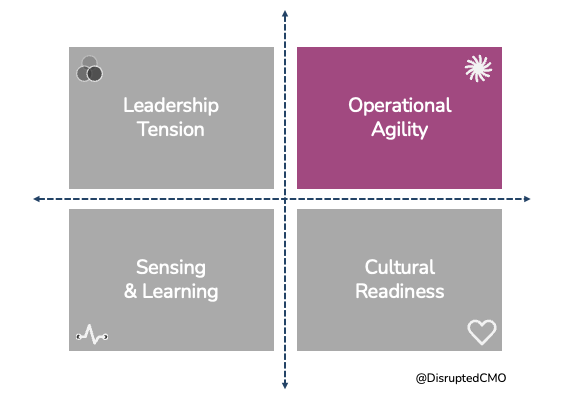
What Operational Agility Actually Means
In the Disruption-Fluent Marketing framework, Operational Agility is defined as "the organization's ability to move from insight to action quickly, reallocate resources fluidly, and work iteratively and flexibly." It comprises four components:
Execution Speed is the elapsed time from insight or decision to market-facing action. Strong execution means clear pathways from insight to action, parallel workflows where possible, and approval processes calibrated to risk level. Weak execution means weeks or months from concept to launch, sequential bottlenecks, and inability to capitalize on time-sensitive opportunities.
Resource Fluidity is the ability to reallocate budget, people, and attention in response to changing priorities. Strong fluidity means reserved capacity for emerging opportunities, clear mechanisms for rapid reallocation, and quarterly or more frequent resource rebalancing. Weak fluidity means annual budgets locked at year start, reallocation requiring multiple approval levels, and new opportunities waiting for the next budget cycle.
Experimentation Rigor is the capacity for structured testing and learning. Strong experimentation means clear hypotheses with defined success criteria, minimum viable tests before full investment, and results that systematically influence future decisions. Weak experimentation means campaigns launched without hypotheses, "testing" that's just execution with post-hoc analysis, and big bets without validation.
Iterative Practice is genuine adoption of agile ways of working—not just ceremonies, but the mindset of continuous delivery, inspection, and adaptation. Strong iterative practice means delivering value in short cycles, retrospectives that drive improvement, and teams empowered to determine how work gets done. Weak iterative practice means stand-ups that are status meetings, sprints that are renamed project phases, and "agile" layered on fundamentally waterfall processes.

Why This Is Your Critical Constraint
Operational Agility serves as "the operational layer": how the system executes. Without it, leadership vision becomes frustration. Insights go stale. Cultural readiness erodes as good ideas consistently die in execution.
The research on Agile adoption in marketing is pretty clear. According to the 2025 State of Agile Marketing Report, 96% of marketers applying Agile ways of working report a very positive experience. Organizations that have embraced full marketing agility are 3x more likely to be extremely successful. Fully Agile teams are 6x as likely to report being much less stressed compared to somewhat Agile teams.
In disruptive environments, speed becomes more valuable than optimization. Organizations unable to execute quickly are systematically disadvantaged when the landscape shifts rapidly.
Diagnosing Your Specific Pattern
Low Organizational Agility scores manifest in different patterns. Understanding yours shapes how you respond.
The Approval Bottleneck: Work piles up waiting for sign-off. Approval chains extend through multiple levels. Governance designed for risk mitigation has grown beyond what's necessary, creating friction that slows all work regardless of actual risk. Not all decisions carry equal risk; approval processes should be calibrated accordingly.
The Waterfall Hangover: Long planning cycles before any execution. Large campaigns launched as monolithic units. "Agile" ceremonies grafted onto fundamentally waterfall processes. The organization has adopted some agile practices but hasn't genuinely shifted to iterative delivery.
The Resource Prison: Can't staff emerging priorities because everyone is allocated. Budget locked at year start with minimal flexibility. Resource allocation processes prioritize predictability over responsiveness. In rapidly changing environments, the ability to reallocate resources is itself a resource—perhaps the most valuable one.
The Activity Trap: Teams are busy but impact is unclear. Work continues because it was planned, not because it's still valuable. The organization optimizes for activity rather than outcomes. Once work begins, momentum carries it forward regardless of whether it remains the right work.
The Path Forward: Developing Organizational Agility
Building Execution Speed
- Map your critical path. For typical work items, what's the actual path from concept to market? Where are the bottlenecks? Often the constraint is in a few specific places, not everywhere.
- Calibrate approvals to risk. Not every decision needs the same governance. Create tiered approval processes where low-risk work moves quickly and only high-risk work gets extensive review.
- Enable parallel work. Sequential handoffs create delays. Structure work to proceed in parallel with coordination points rather than sequential with handoffs.
- Create fast-track mechanisms. For time-sensitive opportunities, have established processes that can compress timelines. Define what qualifies and what gets abbreviated.
For more on right-sizing administrative structure, read Minimum Viable Bureaucracy: The Secret to an Agile Marketing Team.
Building Resource Fluidity
- Reserve capacity for emerging priorities. Don't allocate 100% of resources at planning time. Hold back 10-20% for opportunities that will emerge.
- Shorten budget cycles. If annual budgets are locked, explore quarterly rebalancing. Match resource allocation rhythm to the pace of environmental change.
- Create reallocation mechanisms. Define clear processes for moving resources between initiatives. Make it achievable, not theoretical.
- Make opportunity cost visible. When resources can't move, make the cost clear. "We can't pursue this opportunity because resources are committed to X" creates useful pressure.
Building Experimentation Rigor
- Establish hypothesis discipline. Before launching, articulate what you're trying to learn and how you'll measure it. "We believe X because Y, and we'll know we're right if Z."
- Start smaller. Whatever you're planning to launch, ask: what's the minimum version that would generate useful learning? Launch that first.
- Separate testing from scaling. Testing and scaling require different approaches. Test with minimal investment; scale what's proven.
- Celebrate learning, not just success. Experiments that disprove hypotheses are valuable—they prevent larger investments in approaches that wouldn't work.
Building Genuine Iterative Practice
- Embrace the Agile Marketing values. The Agile Marketing Manifesto articulates five values: customer value over activity, delivering early and often over waiting for perfection, learning through experiments over opinions, cross-functional collaboration over silos, and responding to change over following a plan.
- Implement meaningful sprints. Sprints should deliver completed work that creates value, not just progress on larger efforts. If you can't deliver value in a sprint, your work items may need to be broken down differently.
- Run real retrospectives. A retrospective that doesn't generate action items, or whose action items never get implemented, is theater. Retrospectives should produce visible improvements.
- Make work visible. Kanban boards or similar tools visualize workflow, reveal bottlenecks, enable coordination, and create healthy pressure for completion.
- Invest in training. The 2024 State of Agile Marketing research found that while 78% who used "train the trainer" programs found them valuable, only 23% actually used them. Don't make agility harder than it needs to be.
Common Pitfalls
- Agile as empty ritual. The ceremonies can become empty boxes checked without genuine value. If you're "doing agile" but not experiencing improved outcomes, examine whether you've adopted practices without principles.
- Speed without direction. Moving fast in the wrong direction compounds problems. Agility should serve strategy, not replace it.
- Tool-first transformation. No tool creates agility. Tools can enable and reinforce agile practices, but adopting software doesn't transform operations.
- Agility as chaos. Agility doesn't mean abandoning structure. It means creating structures that enable responsiveness. Minimum Viable Bureaucracy is about right-sizing administrative structure, not eliminating it.
The CMO's Personal Role
- Clear the path. Your position lets you remove obstacles teams cannot remove themselves. Identify bottlenecks and eliminate or streamline them.
- Model the mindset. How you plan, respond to change, and evaluate work signals what matters. If you celebrate learning from failed experiments, you build experimentation culture.
- Protect the process. When pressure mounts, agile practices are often first casualties. Protect them—they're most valuable precisely when pressure is highest.
- Calibrate your governance. Review approval processes with fresh eyes. Where are you adding friction without commensurate value?
- Be patient with the transition. Shifting to genuine operational agility takes time. Early stages often feel slower as new practices are learned.
The Payoff
When Operational Agility improves, everything accelerates. Sensing & Learning generates impact as realtime insights translate to timely action. Leadership tensions becomes easier to navigate. Cultural readiness strengthens as good ideas actually happen and hard work translates to impact.
Most importantly, your organization becomes genuinely responsive, able to capitalize on opportunities and respond to threats at the pace the environment demands.
Next Steps
- Map your bottlenecks. Where does work actually slow down? Approvals, handoffs, resource constraints?
- Audit your agile maturity. Are you practicing genuine agility or agile theater? Are retrospectives producing change?
- Examine your resource allocation. How much flexibility do you actually have? What would it take to increase it?
- Start one genuine experiment. Pick a strategic question, form a hypothesis, design a minimum viable test, and run it with discipline.
To assess where your organization stands across all four dimensions of disruption fluency, explore the Disruption Fluency Audit.
In the meantime, please feel free to reach out to start a conversation!


