
Critical Constraints: Cultural Readiness is the Foundation
Why your investments in Agile, market intelligence, and leadership development may be operating at a fraction of their potential, and what to do about it.


[This post is helpful reading on its own, so feel free to read on, however it's intended for anyone who completed the Disruption-Fluency Self-Assessment. I encourage you to start there.]
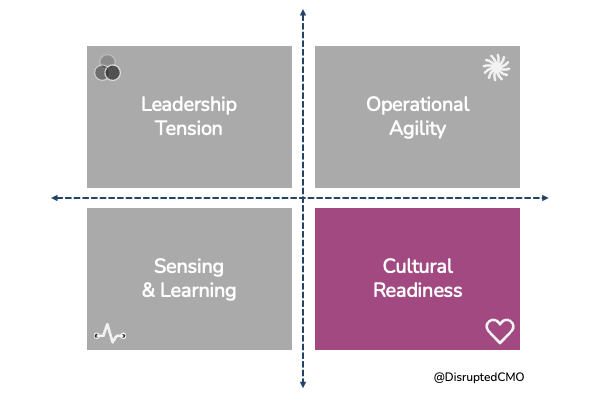
If you've assessed your marketing organization's disruption fluency and Cultural Readiness came back as your lowest-scoring dimension, you're facing a sobering reality: all your other investments are likely underperforming.
Cultural Readiness isn't just one dimension among many: it's the foundation upon which everything else rests.
You can have the most sophisticated sensing and marketing intelligence systems, the most agile and flexible operational processes, and the most capable leaders. But if your team doesn't feel safe to speak up, experiment, fail, and learn openly, none of it may matter when it comes to successfully navigating disruption.
What Cultural Readiness Actually Means
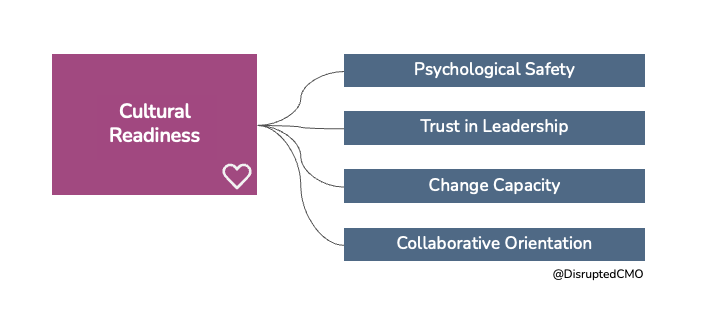
In the Disruption-Fluent Marketing framework, Cultural Readiness is defined as "the human foundation that makes everything else possible." It comprises four interconnected sub-dimensions:
Psychological Safety is the shared belief that a team is safe for interpersonal risk-taking. Harvard Business School professor Amy Edmondson, who pioneered this research, defines it as "the belief that you can speak up with ideas, questions, concerns, or mistakes without fear of repercussions."
In marketing organizations lacking psychological safety, project and go-to-market failures get hidden rather than analyzed. Team members nod along in meetings but voice concerns privately afterward, if at all. Bold, innovative proposals that may challenge the accepted wisdom die quietly. The same mistakes get repeated because no one feel comfortable talking about what went wrong.
"Psychological safety at work doesn't mean everybody is nice to each other all the time. It means people feel free to 'brainstorm out loud,' voice half-finished thoughts, openly challenge the status quo, shared feedback, and work through disagreements together" - Center for Creative Leadership
Trust in Leadership operates on multiple levels: trust that leadership will act with integrity, that decisions will be made transparently, and that leadership will support the team through uncertainty. Patrick Lencioni's research on team dynamics identifies absence of trust as the foundational dysfunction from which all others cascade.
Change Capacity reflects the organization's track record with change initiatives and the collective confidence - or exhaustion - that results. Organizations with depleted change capacity exhibit "change fatigue" that manifests as passive resistance, cynicism about new initiatives, and superficial compliance without genuine commitment.
Collaborative Orientation describes the extent to which people naturally work across boundaries versus protecting their territory. When it's strong, cross-functional teams form organically during crises. When it's weak, you see information hoarding, "throw it over the wall" handoffs, and internal competition that outweighs external focus.
Why This Is Your Most Critical Constraint
The Four Dimensions of Disruption Fluency create a reinforcing loop.
- Cultural safety enables adaptive leadership to emerge.
- Enabling leaders protect and scale adaptive work.
- Operational agility translates adaptive solutions into rapid execution.
- Sensing mechanisms capture learning from execution.
- Learning flows back, informing the next adaptation.
- Success builds trust and confidence.
- Increased cultural safety enables more adaptive leadership.
When Cultural Readiness is weak, you get the opposite spiral: Cultural fear suppresses adaptive work. Innovations die in bureaucracy. Operational rigidity prevents response even when the need is clear. Failure to learn means repeating mistakes. Repeated failures erode trust. The cycle spirals downward.
The research is unambiguous. Google's Project Aristotle, their multi-year research initiative to understand what makes teams effective, found that psychological safety was "by far the most important" of the five dynamics that distinguish high-performing teams, correlated with 43% of the variance in team performance.
For marketing leaders specifically, consider this: The pace of change in our discipline - AI transformation, privacy evolution, channel fragmentation, cultural shifts - demands exactly the kind of experimental, adaptive behavior that psychological safety enables. Organizations without it aren't just underperforming; they're systematically prevented from adapting to disruption.
Diagnosing Your Specific Pattern
Low Cultural Readiness scores manifest in different patterns. Understanding yours shapes how you respond.
The "Nice" Culture: Meetings are pleasant but unproductive. Disagreement happens in hallways, not conference rooms. Problems are described as "challenges" or "opportunities." This is what Lencioni calls "artificial harmony"; it feels safe but actually isn't, because real concerns go unaddressed and real learning doesn't happen.
The Burned-Out Culture: Eye-rolling at new initiatives. "We tried that before" as a conversation-ender. High performers leaving or disengaging. This culture was often healthy once. Too many failed change initiatives have depleted trust and capacity. The organization has learned that resistance is rational.
The Fear Culture: Blame-first responses to problems. Information hoarding. Leaders surprised by problems they should have known about earlier. Often created inadvertently through a single high-profile incident that became organizational legend.
The Siloed Culture: Strong team identities, weak organizational identity. Internal competition outweighing external focus. Often reflects rational responses to poorly designed incentive structures. Fixing it requires addressing structural issues, not just exhortations to collaborate.
The Path Forward: Three Leadership Behaviors
Edmondson's framework for building psychological safety provides a useful structure that applies across all Cultural Readiness components.
Frame the Work
Cultural change starts with how leaders describe what the organization is trying to accomplish. Rather than positioning change as threat or mandate, describe it as exploration requiring everyone's input: "We're entering territory none of us have mapped before. We'll need everyone's perspective to navigate it well."
Counterintuitively, admitting what you don't know creates more safety, not less. When you say "I'm not sure this will work, and I need your help figuring it out," you're modeling the vulnerability you want to see.
Connect to purpose beyond tactics. Don't just announce "we're going Agile." Articulate why: "To ensure we can serve customers with the speed and relevance they expect in a world where competitive advantages last months, not years."
Invite Participation
Psychological safety isn't created by declaring it exists. It's created through repeated demonstrations that input is genuinely valued.
Move from closed questions ("Does anyone have concerns?") to open, inviting questions ("What are we missing?" "What would you do differently?" "Who sees this differently?"). Ask specifically for dissenting views: "I've shared my perspective. Now I want to hear what's wrong with it."
Don't accept silent meetings as agreement. When you get silence, try: "Let me rephrase—what's the strongest argument against what I just proposed?"
When someone pushes back, resist the temptation to immediately rebut. Instead: "Tell me more about that concern. What are you seeing that I'm not?"
Respond Productively
This is where cultural readiness is made or broken. How leaders respond to input, especially bad news, mistakes, and dissent, determines whether people will speak up again.
Thank people for speaking up, especially when the news is hard. Before addressing the substance, acknowledge the courage: "Thank you for raising that. It's exactly the kind of thing I need to hear."
Never punish the messenger. This seems obvious but happens constantly in subtle ways: exclusion from subsequent meetings, changed tone, fewer opportunities. The first time someone sees this happen (even to someone else), they learn to stay quiet.
Act visibly on input. Nothing kills participation faster than input that disappears into a void. Close the loop: "Remember when Emma raised that concern about the campaign timeline? Here's what we changed as a result."
Model your own fallibility. Share your own mistakes and what you learned. When you personally participate in retrospectives, admit what you got wrong, and ask for feedback on your leadership, you're demonstrating the behavior you want to see.
The CMO's Personal Responsibility
The really uncomfortable reality is that Cultural Readiness starts with you.
Your behavior sets the tone. Your responses to bad news determine whether people will deliver bad news. Your willingness to be vulnerable determines whether others will be. Your consistency between words and actions determines whether you're trusted.
This is simultaneously daunting and empowering. You can't buy cultural readiness, but you can create it, starting with your own behaviors.
Before trying to change the broader organization, focus on your direct reporting team. Can they disagree with you openly? Do they bring you bad news promptly? Do they ask for help when they need it? If not, start there.
The Payoff
When Cultural Readiness improves, everything else in the Disruption-Fluent Marketing framework becomes possible. As mentioned, it's the real foundation of this approach. Leadership tension management improves because productive conflict becomes possible in psychologically safe environments. Operational agility accelerates because people share information freely, iterate openly, and learn from failures. Sensing and learning capacity expands because insights flow through the organization rather than being hoarded or suppressed.
Most importantly, your organization develops the built-in capacity to genuinely thrive amid disruption.
Where Do You Go From Here?
- Assess your specific pattern. Is your culture "nice," burned out, fearful, or siloed? Understanding the specific challenge shapes the intervention.
- Start with yourself. Before any organizational initiative, examine your own behavior. What are you modeling? How are you responding to dissent, mistakes, and bad news?
- Have one honest conversation. This week, create space for one team member to tell you something they've been hesitant to share. Listen without defending. Thank them. Act on what you learn.
- Commit to the long game. Cultural readiness isn't built in a quarter. Plan for sustained effort over 12-24 months.
To assess where your organization stands across all four dimensions of disruption fluency, explore the Disruption Fluency Audit.
In the meantime, please feel free to reach out to start a conversation!


