
Critical Constraints: Building Sensing & Learning Capability
Why your marketing organization keeps getting surprised by change, and how to build the radar you need.


[This post is helpful reading on its own, so feel free to read on, however it's intended for anyone who completed the Disruption-Fluency Self-Assessment. I encourage you to start there.]
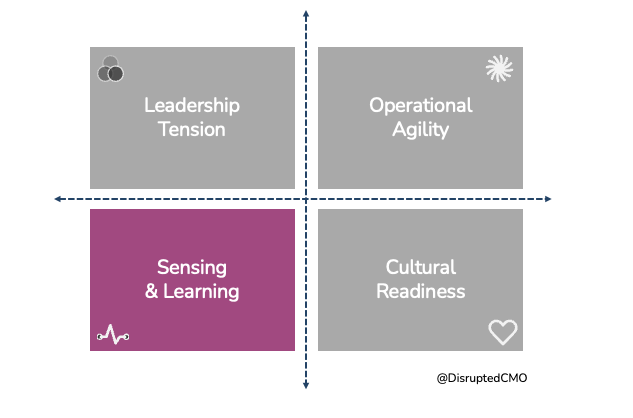
If your Disruption Fluency Assessment identified Sensing & Learning as your lowest-scoring dimension, your organization faces a critical vulnerability: you're navigating an increasingly turbulent environment without the radar to detect what's coming or the systems to learn from what you've experienced.
Organizations weak in Sensing & Learning exhibit a troubling pattern: they're perpetually surprised. Market shifts that competitors anticipated catch them off guard. The same mistakes recur across teams and over time. Valuable insights from campaigns and customer interactions evaporate rather than accumulating into organizational wisdom.
What Sensing & Learning Actually Means
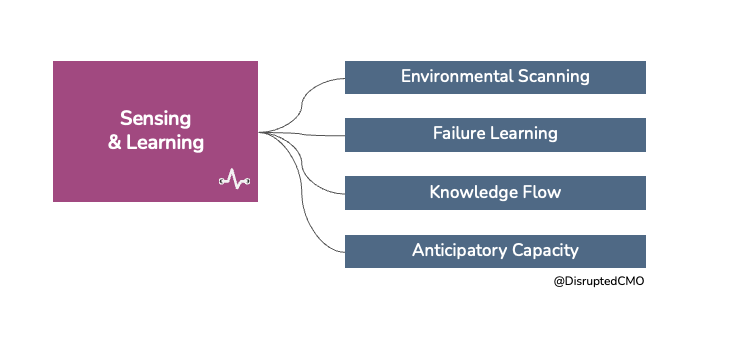
In the Disruption-Fluent Marketing framework, Sensing & Learning is defined as "the capacity to detect emerging changes in the environment from all sources and systematically convert experience into organizational knowledge." It comprises four interconnected components:
Environmental Scanning is the systematic monitoring of forces that could affect your marketing organization: technology shifts, competitive moves, consumer behavior changes, cultural trends, regulatory developments. Strong scanning means diverse information sources, structured monitoring across domains, and regular synthesis that connects dots across activities. Weak scanning means relying primarily on internal data, being consistently late to industry trends, and reactive rather than predictive competitive intelligence.
Failure Learning is the organization's capacity to extract insight from setbacks. In marketing, where not every campaign succeeds, this determines whether failures become investments in future success or simply costs to be absorbed. Strong failure learning means blameless retrospectives, documented learnings that are accessible and referenced, and leaders who share their own failures openly. Weak failure learning means post-mortems focused on blame, the same types of failures recurring, and risk aversion that prevents the experimentation needed to discover what works.
Knowledge Flow describes how insights move through the organization: capture, storage, retrieval, and application. Strong knowledge flow means accessible repositories, regular cross-team sharing, and active curation. Weak knowledge flow means insights trapped in email threads, new team members having no access to institutional knowledge, and knowledge loss when employees leave.
Anticipatory Capacity is the organization's ability to look forward, developing informed perspectives on what's likely to happen next. Strong anticipatory capacity means regular horizon scanning, scenario planning that shapes choices, and a track record of early moves competitors later follow. Weak anticipatory capacity means strategy based on extrapolating current trends, being consistently late to emerging channels, and viewing disruption as something that happens to you.
Why This Is Your Critical Constraint
Sensing & Learning serves as "the intelligence system" that feeds all other dimensions. Without it, Leadership Tension management becomes guesswork: how do you know when to emphasize adaptive versus administrative approaches if you can't sense what challenges require which response? Operational Agility lacks direction; you can move fast, but toward what? Speed without sensing leads you to move quickly in the wrong direction.
Peter Senge's seminal work on learning organizations, The Fifth Discipline, argues that "the only sustainable competitive advantage is your organization's ability to learn faster than the competition." This insight is particularly acute for marketing organizations, where AI is transforming not just what marketers can do but the speed at which everything changes.
As the 2025 State of Agile Marketing Report notes, "In 2025, AI is transforming how marketers operate with every passing week." Organizations with strong sensing and learning capabilities are positioned to ride this wave; those without are positioned to be overwhelmed by it.
Diagnosing Your Specific Pattern
Weak Sensing & Learning manifests differently across organizations:
The Internally Focused Organization relies heavily on internal metrics and historical data, with competitive intelligence limited to public announcements. The root cause is absorption in executing current strategy to the exclusion of monitoring the external environment. Internal data tells you what happened, not what's emerging.
The Data-Rich, Insight-Poor Organization has abundant data, sophisticated dashboards, and analytics teams producing regular outputs, yet decisions still feel disconnected from insight. The constraint is typically in interpretation and application, not collection. More data doesn't equal better sensing.
The Amnesia Organization generates insights but doesn't capture, organize, or apply them. Campaign learnings aren't documented, knowledge concentrates in individuals, and the same mistakes recur. As Senge observed, "Organizations learn only through individuals who learn. Individual learning does not guarantee organizational learning."
The Reactive Organization is consistently late to emerging trends, with all attention absorbed by current operations and no capacity allocated to looking ahead. In rapidly changing environments, reactive approaches guarantee you're always one step behind.
The Path Forward: Developing Sensing & Learning in Your Organization
Building Sensing Capability
- Create structured scanning domains. Define the specific domains most relevant to your business—technology evolution, competitive moves, consumer behavior shifts, cultural trends, regulatory changes, channel dynamics—and assign responsibility for each.
- Diversify information sources. Combine formal research with informal intelligence. Your sales team, customer service, agency partners, and frontline marketers all have sensing capabilities that often go untapped. Create channels for this informal intelligence to surface.
- Establish scanning rhythms. Monthly competitive reviews, quarterly technology assessments, regular customer insight synthesis. Rhythm creates consistency; consistency builds capability.
- Look beyond your category. The most significant disruptions often come from adjacent industries or entirely different sectors. Include cross-industry scanning in your routine.
Building Learning Capability
- Reframe failure as investment. "Intelligent failure" or "productive failure" signals that some failures are valuable learning opportunities. Distinguish between failures from carelessness and failures from experimentation in uncertain conditions.
- Conduct blameless retrospectives. Adopt practices from high-reliability industries where understanding what happened matters more than assigning responsibility. Focus on systems and processes, not individuals.
- Document and share learnings. A retrospective that isn't documented produces individual learning at best. Organizational learning requires both documentation and sharing.
- Create pattern recognition. Periodically review failures across teams and time to identify patterns. Individual failures may be random; patterns indicate systemic issues worth addressing.
For more on creating environments where learning thrives, read Harness Productive Tension to Fuel Marketing Innovation.
Building Knowledge Flow
- Start with capture. Establish lightweight but consistent practices for documenting campaign learnings, market insights, and strategic decisions.
- Make knowledge findable. A knowledge repository that no one can navigate is worse than useless. Invest in organization and search.
- Create sharing mechanisms. Regular insight-sharing sessions, communities of practice, internal conferences. Knowledge flows through connection, not just storage.
- Appoint knowledge stewards. Someone needs to own the quality and currency of shared knowledge. Without stewardship, repositories become graveyards.
Building Anticipatory Capacity
- Allocate time for the future. If 100% of your team's capacity is absorbed by current operations, anticipatory sensing won't happen. Protect time for horizon scanning, even if it's a small percentage.
- Practice scenario planning. Not as an annual retreat exercise but as an ongoing capability. What signals would indicate each scenario is emerging?
- Track weak signals. Create mechanisms for capturing and tracking early indicators of potential shifts. Not every weak signal matters, but the ones that do matter a lot.
- Question assumptions. The most dangerous blind spots are often assumptions so fundamental you don't recognize them as assumptions. Periodically surface and challenge the assumptions underlying your strategy.
The CMO's Unique Role
As CMO, you have unique responsibilities for building Sensing & Learning capability:
- Model curiosity. Ask questions. Seek diverse perspectives. Demonstrate that not knowing is acceptable and that intellectual curiosity is valued.
- Allocate resources. Sensing and learning require investment in time, technology, and people. These investments won't happen unless leadership prioritizes them.
- Protect learning time. When pressure mounts, learning activities are often the first casualties. Protect these activities even when, or especially when, the pace is intense.
- Connect the dots. Your position gives you visibility across the organization that individual teams lack. Use it to identify patterns, connect insights across domains, and ensure learning flows to where it's needed.
The Payoff
When Sensing & Learning improves, everything else in the Disruption-Fluent Marketing framework gains power. Leadership tension management becomes informed. Operational agility gains direction. Cultural readiness strengthens as the organization demonstrates it can anticipate change and learn from experience.
Next Steps
- Diagnose your pattern. Is your organization internally focused, data-rich but insight-poor, suffering from amnesia, or chronically reactive?
- Audit your current scanning. What domains are you systematically monitoring? Where are the obvious gaps?
- Assess your knowledge infrastructure. Where do campaign learnings go? How would a new team member access institutional knowledge?
- Allocate anticipatory capacity. Ensure some percentage of team attention goes to horizon scanning and future-focused thinking.
To assess where your organization stands across all four dimensions of disruption fluency, explore the Disruption Fluency Audit.
In the meantime, please feel free to reach out to start a conversation!


